
Concept
Pitch Deck
Branding
Behance
Dribbble
Fathom + Hatch is a strategy and cultural intelligence consultancy working with some of the world's most demanding organizations. Spotify, Pfizer, Johnson & Johnson, Samsung. Their positioning is rigorous, their methodology is proprietary, and their clients expect to see that reflected before a conversation even begins.
The brief: design a pitch deck that earns authority in the room with senior decision-makers, and communicates F+H's dual identity. deep cultural fathoming, and sharp strategic hatching
Consultancies at this level don't win on aesthetics. They win on perceived authority and intellectual clarity. The deck had to feel like it came from an organization that has spent decades thinking rigorously, not from an agency that just learned how to use Figma.
The core tension: F+H sits at the intersection of cultural anthropology and hard business strategy. Go too academic, it reads like a research paper. Go too polished, you lose the gravitas that makes a senior client feel safe handing over a six-figure engagement. The deck also needed to work for two different readers in the same room, C-suite stakeholders who want strategic clarity, and insight leads who want methodological confidence.
Four directions were developed, each exploring a different register of authority. Two leaned into a dark, immersive aesthetic deep backgrounds, portrait photography, high-contrast typography. placing F+H in the same visual tier as premium management consultancies, but with a distinctly human edge. The other two worked within a lighter, teal-forward system: cleaner, more approachable, built for contexts where the deck travels without a presenter and needs to stand on its own.
Across all four, the structural logic stays consistent: lead with positioning, establish credibility through social proof, then walk through methodology. The narrative arc mirrors F+H's own consulting process, Fathom first, Hatch second. The final recommendation was to use the darker, cinematic direction for live pitch settings, and adapt the lighter system for proposals and leave-behinds read asynchronously.
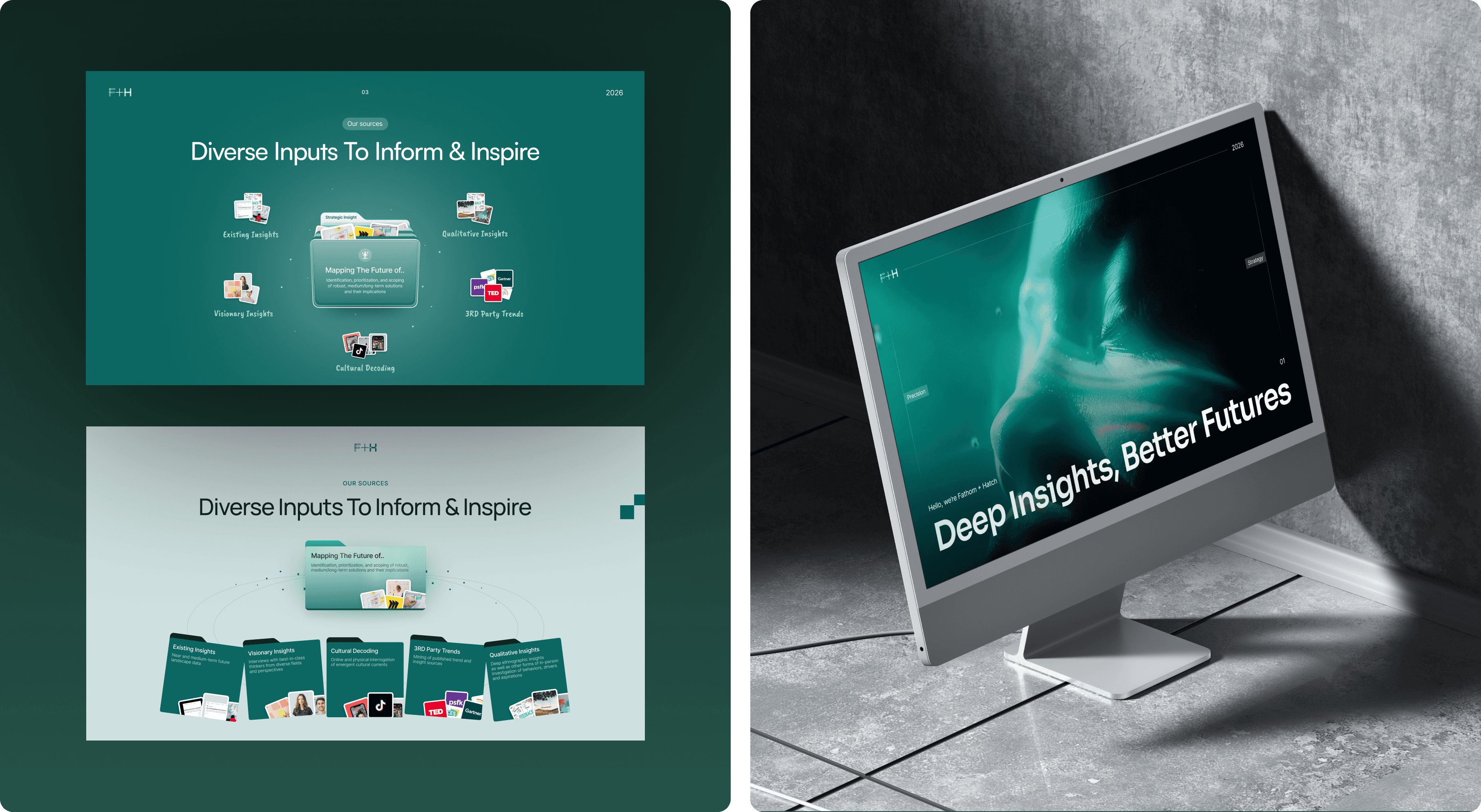
One of the clearest wins in the deck is how F+H’s source methodology is visualized, not just described. The “Diverse Inputs” slide maps five input types. Existing Insights, Qualitative Insights, Visionary Insights, 3rd Party Trends, and Cultural Decoding, around a central strategic output. Instead of bullets, two visual directions were explored: a radial, folder-based layout that signals breadth at a glance, and a cascading card structure that highlights depth and sequence. Both reinforce the same point: F+H operates through multiple lenses, with each format supporting a different presentation style.
This matters because methodology is where consultancy deals are won or lost. When a prospect can see the inputs before they hear the pitch, it shifts the conversation from "what do you do" to "how soon can we start." The deck gave F+H a visual system that doesn't just look credible, it makes their thinking visible, which is the hardest and most valuable thing a pitch deck can do.